
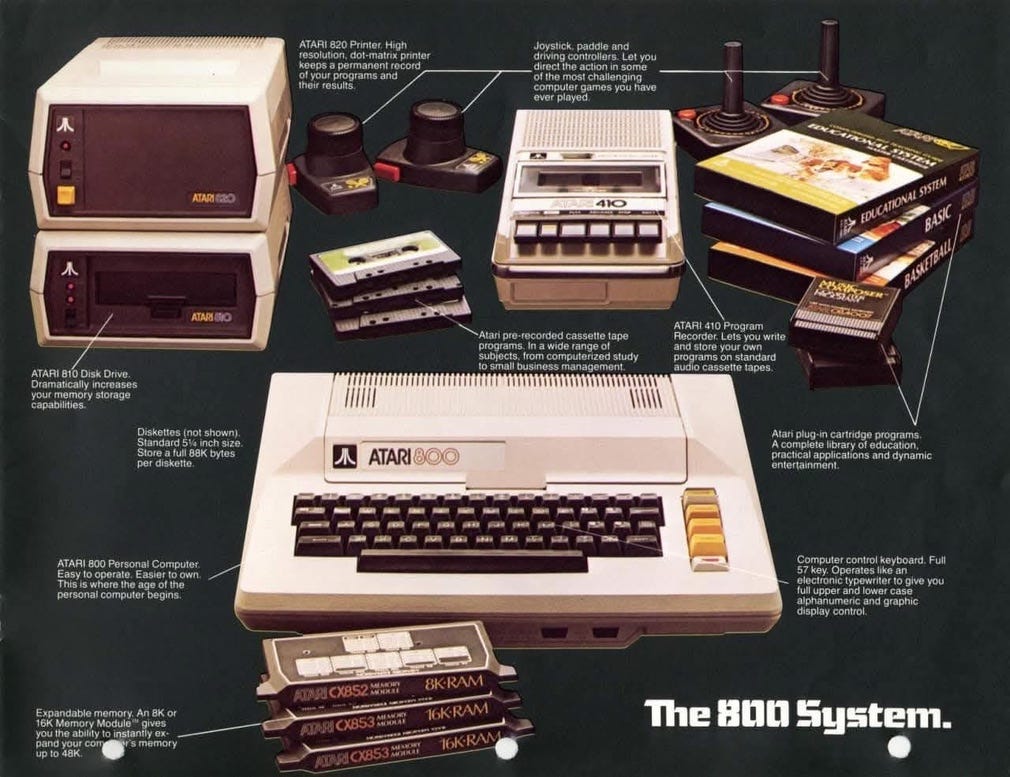
There comes a moment in every aging Gen Xer’s life when they look at their $3,000 MacBook Pro—this impossibly thin slab of aluminum that can render entire cinematic universes while simultaneously selling your browsing history to twelve different ad networks—and think: remember when computers were bad?
Not “bad” like “this update bricked my printer.”
Bad like sincere.
The Atari 800 Was a Little Freak and I Loved It
Picture this. It’s 1983. You turn on your Atari 800. It doesn’t boot to a login screen. It doesn’t ask for your Apple ID. It doesn’t quietly phone home to Cupertino to report that you’ve been googling “how to make sourdough starter” at 2 AM.
It boots to BASIC.
Just a blinking cursor and the overwhelming sense that the machine has handed you the keys to something you are absolutely unqualified to operate.
basic
10 PRINT "BUTTS"
20 GOTO 10
Boom. You are now a programmer. Put it on your LinkedIn. You have made the computer do a thing. The computer didn’t ask for permission. It didn’t make you sign a terms-of-service agreement written by a team of Stanford lawyers. It just said: “Here’s 48K. Knock yourself out.”
And we did. We knocked ourselves all the way out.
Computers Used to Be Legible
Here’s what nobody tells you about modern computing: you don’t own anything anymore. You rent. You subscribe. You log in. Your documents live in a server farm in Virginia next to a nuclear reactor and a guy named Doug who keeps the cooling pumps running. You don’t know where your data is. You don’t know what your software is doing. You click a button and seventeen microservices spin up in Singapore to tell you the weather.
The Atari 800? You could understand that bad boy. You could peek and poke memory addresses like you were performing open-heart surgery on a very patient robot. You could make sprites move. You could change the border color to something that would burn your retinas. You could crack open a program someone traded you on a floppy disk at school and actually figure out how it worked.
The boundary between “person who uses computer” and “person who makes computer do weird stuff” was basically nonexistent. One minute you’re playing Star Raiders. The next you’re typing a program out of Compute! magazine. The next you’re modifying it because you want the alien to be purple instead of green. The next you’re a software engineer making $180K a year and wondering how you got here.
The answer: you were bored and the machine let you be curious.
The GRONK-GRONK-GRONK of Authenticity
But let’s not get too romantic.
Retrocomputing nostalgia has a convenient memory leak. You remember the joy of booting M.U.L.E. You forget that “booting” meant listening to your floppy drive make a sound like a robot eating gravel for four and a half minutes. You remember the chunky pixels. You forget the RF interference that made your screen look like it was receiving transmissions from a dying Soviet satellite. You remember the satisfying clunk of the disk drive.
You forget the GRONK-GRONK-GRONK—that horrifying mechanical death rattle when sector 347 decided it simply wasn’t going to exist today, and neither was your book report.
And yet. And yet.
Here we are in 2026, surrounded by screens that are thin, cheap, light, huge, and razor-sharp—the exact future we wished for in 1982—and we’re out here on eBay bidding $600 for a 13-inch CRT that weighs half as much as a Honda Civic and displays fewer pixels than a digital watch.
Why?
Because modern computers are appliances. Early computers were companions. Messy, frustrating, deeply weird companions that occasionally ate your homework but never asked you to upgrade to BASIC Pro Plus for $8.99/month.
The Real Drug Was the Mystery
You can’t buy back the feeling of sitting in front of an Atari in 1981 and genuinely not knowing what this thing was going to become. Nobody knew. The computer was still new. It still had mystery. It was a box full of lightning that might turn out to be a toy, a tool, a telephone, a television, or the entire global economy. You were watching a new species of human invention evolve in real time.
You can’t recreate that by buying vintage hardware. You can hear the disk drive. You can smell the ozone. You can hold the joystick until your hand cramps. But you can’t get back the feeling of “What the hell is this thing going to become?”
Because now we know. It became this. It became a world where your refrigerator has Wi-Fi and your doorbell is a surveillance device and your phone is designed to make you slightly sad on purpose so you scroll longer.
And maybe that’s why we keep buying the CRTs. Not because the old computers were better. They weren’t. They were terrible in a hundred different ways.
But at least they were ours.
At least they let us wonder.
TL;DR: I spent six hundred dollars on a tube that can give me radiation poisoning to play a game that looks like it was drawn by a very angry calculator, and honestly? I might do it again.
The disk drive made a satisfying clunk. No subscription required.
Leave a Reply